



Commercial Window Tinting in Bend, OR: Alpha Shielding LLC
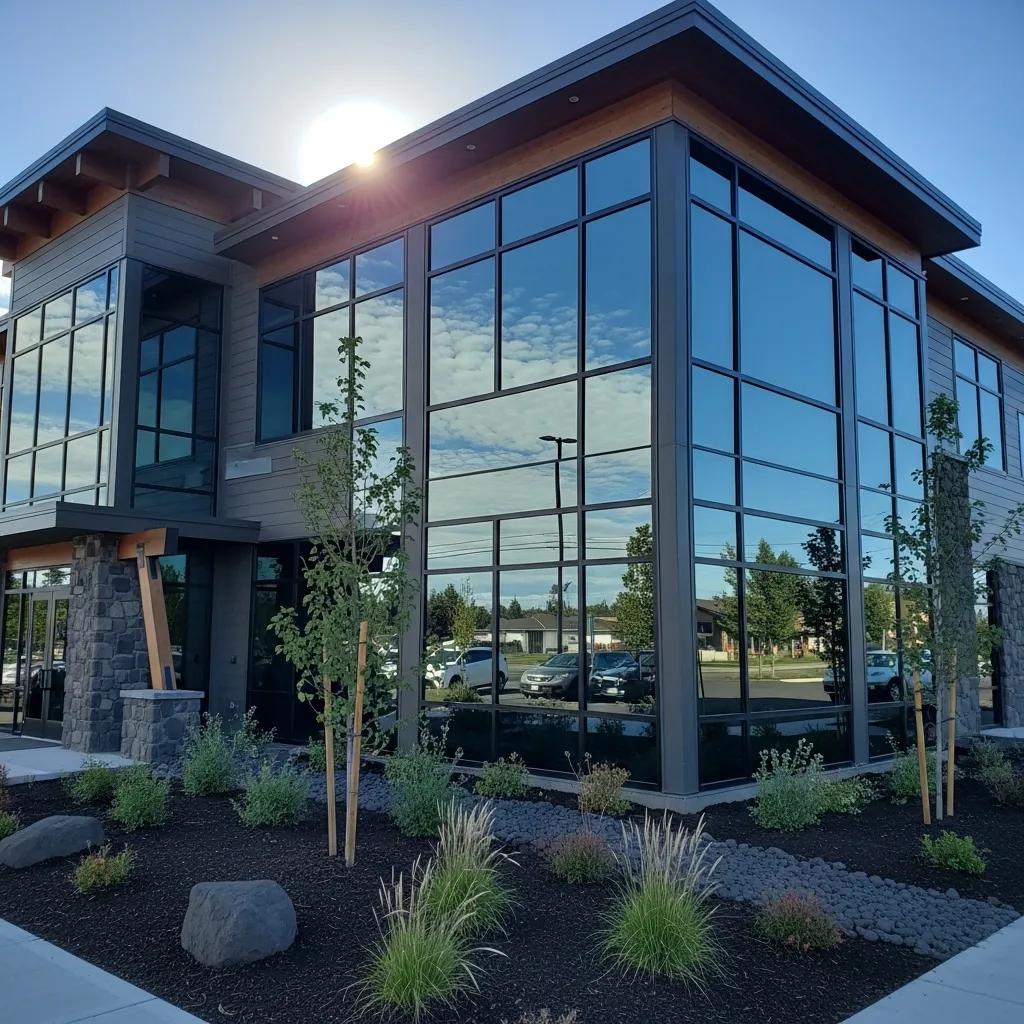
Commercial window tinting is a retrofit that applies engineered window film to existing glass to manage solar heat gain, cut glare, block UV radiation, and improve safety. This guide breaks down how window film works, why it matters for building performance in Bend, Oregon, and how facility managers can evaluate options for offices, retail, healthcare, and multi-tenant properties. If your building wrestles with hot west-facing facades, faded interiors, or high cooling bills, you’ll find practical advice on choosing the right film, installation best practices, cost expectations, and maintenance strategies tuned to Bend’s sun angles and seasonal swings. We explain benefits (energy, comfort, security), film categories and performance metrics (VLT, SHGC, IR rejection), a step-by-step installation workflow, cost drivers and quoting tips, plus maintenance and lifespan expectations. Technical terms like solar control window film, ceramic film, security film, VLT, SHGC, and IR rejection are defined so both technical and non-technical stakeholders can decide with confidence.
What are the main benefits of commercial window tinting for Bend businesses?
Window film delivers measurable gains in energy performance, occupant comfort, UV protection, and safety by changing how glass transmits visible light and infrared heat. Properly selected films reduce solar heat gain and IR transmission, lowering peak cooling loads and smoothing temperature swings so occupants experience fewer hot spots. In retail and office spaces this cuts glare on displays and monitors and can block up to 99% of UV radiation, protecting furnishings and inventory from fading. Below are the principal, measurable benefits Bend property managers should expect.
Core benefits of commercial window tinting:
Energy savings: Reduces solar heat gain through glazing, which can lower cooling energy use and peak HVAC demand.
UV protection: Blocks the vast majority of UV radiation to slow fading of interiors and protect occupants.
Glare reduction: Controls reflected and transmitted glare to improve productivity and display visibility.
Security & safety: Safety films help keep glass fragments intact on breakage, reducing injury and deterring forced entry.
Privacy & aesthetics: Frosted and decorative films increase privacy and let you add branded graphics without replacing glazing.
Those benefits translate to lower monthly energy bills, longer-lasting furnishings, fewer tenant complaints about hot spots, and reduced security risk—making film a high-impact retrofit for many buildings. The next section digs into the energy and comfort mechanics so you can estimate likely savings and occupant impact.
At Alpha Shielding, we install commercial window film that cuts heat, reduces glare, and lowers energy costs while improving comfort and security. We select high-performance films for each building and install them precisely to meet your goals.
How does commercial window tinting lower energy costs and improve comfort?

Window film reduces energy use mainly by lowering the Solar Heat Gain Coefficient (SHGC) of glazed areas—reflecting or absorbing near-infrared (IR) radiation before it turns into interior heat. Films with high IR rejection and balanced Visible Light Transmission (VLT) let daylight in while preventing heat buildup, which cuts peak cooling loads and shortens HVAC run times. For example, a west-facing storefront in Bend fitted with spectrally selective ceramic film will see reduced interior solar load and lower midday cooling demand; total savings vary with orientation, glazing area, and your HVAC baseline.
Reducing peak HVAC cycles also improves comfort by eliminating hot spots near windows and stabilizing temperatures across zones.
These effects can extend HVAC life by reducing extreme runtimes and thermal stress. Choosing the right balance between VLT (daylight) and SHGC (heat) is key so occupants keep natural light without the thermal penalty. The next section covers UV and glare performance and typical protection levels.
How much UV protection and glare reduction can window film provide?
Most commercial window films block up to 99% of ultraviolet (UV) radiation—the main driver of fading in fabrics, wood finishes, and printed materials—so film preserves interiors and inventory and protects long-term asset value. Glare reduction is measured by changes in visible light transmission and reflected glare; films that lower direct-sun luminance or redirect transmitted light can substantially cut perceived glare, improving monitor visibility and customer comfort. For sensitive spaces—museums, retail displays, conference rooms—pairing spectrally selective film with interior shading gives the best balance of daylighting and glare control. Facility managers typically choose films by specifying VLT percentage and UV rejection targets to match each use case.
Industry literature supports the use of spectrally selective films to reduce solar gain, glare, and UV exposure in commercial glazing.
Spectrally Selective Window Films for Commercial Buildings After-market window films address this need effectively. Manufacturers offer a range of films that reduce passive solar gain, cut glare, and block UV radiation to meet varied end-user requirements. Spectrally selective window films, 2007
Blocking UV also lowers cumulative occupant exposure near windows and helps reduce visual fatigue from glare—both factors that influence productivity and comfort. With that in mind, the following section compares film categories that perform well in Bend’s climate.
Which types of commercial window films work best in Bend’s climate?
Picking the right film means balancing visible light, IR rejection, UV blocking, appearance, and security needs against budget and building orientation. Bend’s high day‑to‑night temperature swings and strong solar angles favor films that reject IR while preserving useful daylight—ceramic and spectrally selective options excel here. Security and privacy films are useful where safety or confidentiality is a priority, and decorative films deliver branding or wayfinding without swapping out glass. The table below compares common film types by key performance attributes so facility managers can match numeric metrics to Bend conditions.
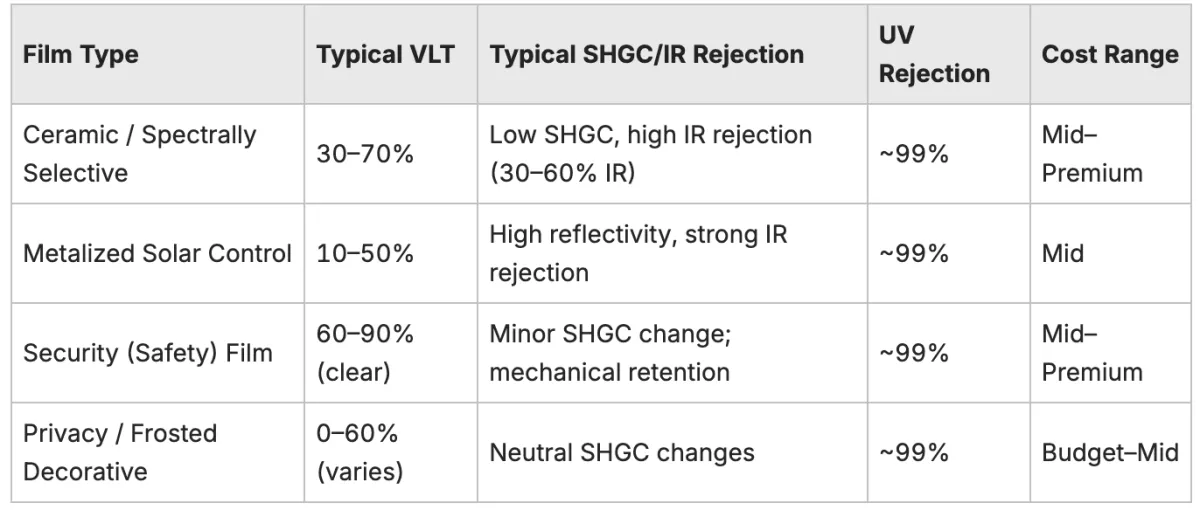
As the table shows, ceramic and spectrally selective films are often the best first choice for Bend properties that need daylight with meaningful heat control. The next paragraphs outline solar-control film features and where to use them.
Alpha Shielding installs commercial window films designed to cut heat, glare, and energy costs while improving occupant comfort and security. We match film choice to each building and execute installations with care and attention to detail.
What features make solar control and ceramic films useful?
Ceramic and spectrally selective films use non-metal ceramic particles to block IR and portions of the near-IR spectrum while keeping visible transmission higher—so they reduce heat without overly darkening interiors. Typical construction includes a polyester film layer, adhesive, a scratch-resistant topcoat, and a ceramic particle layer that together deliver durability, strong adhesion, and stable optics. Unlike metalized films, ceramic options avoid metallic reflectivity and signal interference while holding long-term clarity and neutral color. For large storefronts or glazing where daylight and display visibility matter, ceramic films offer an attractive SHGC-to-VLT ratio that keeps interiors bright while lowering cooling loads.
Advances in spectrally selective thin films have enabled highly efficient, energy-saving window solutions.
Spectral Selective Thin Films for Energy Efficient Windows Spectrally selective designs and metal-based thin films are a promising approach to allow high visible light transmittance while reflecting near-infrared energy—an effective strategy for energy-efficient windows. Spectral selective and photothermal nano structured thin films for energy efficient windows, D Shi, 2017
Durability and lifecycle performance tend to favor ceramic options on high-exposure facades, and their neutral appearance supports architectural intent. After covering solar-control films, the next section looks at security, privacy, and decorative options for safety and branding needs.
How do security, privacy, and decorative films enhance commercial buildings?
Security (safety) films are engineered to hold glass fragments together on impact, enhancing occupant protection and delaying or deterring forced entry while typically preserving daylight. These films come in varying thicknesses and are installed with specialized adhesives and edge treatments to boost smash- and blast-resistance for storefronts and ground‑floor glazing. Privacy films—frosted, opaque, or reflective—manage sightlines for conference rooms, restrooms, and healthcare spaces, while decorative films allow logos, patterns, or wayfinding graphics without replacing glass. Anti-graffiti films act as a sacrificial layer in vandal-prone areas and are cheaper to replace than entire panes.
When preserving sensitive materials is critical, UV-blocking films are an essential part of environmental control strategies.
UV-Blocking Window Films for Artifact Preservation Institutions commonly use window films to block unwanted solar radiation. Darker films tend to offer higher UV rejection and are therefore used in museums and galleries where artifact preservation is a priority. UV-blocking window films for use in museums—revisited, 2010
Choosing among these options depends on function: safety films for protection, privacy films for confidentiality and compliance, and decorative films for brand expression. The next section explains how professional installations make these benefits reliable.
How is commercial window tinting installed in Bend?
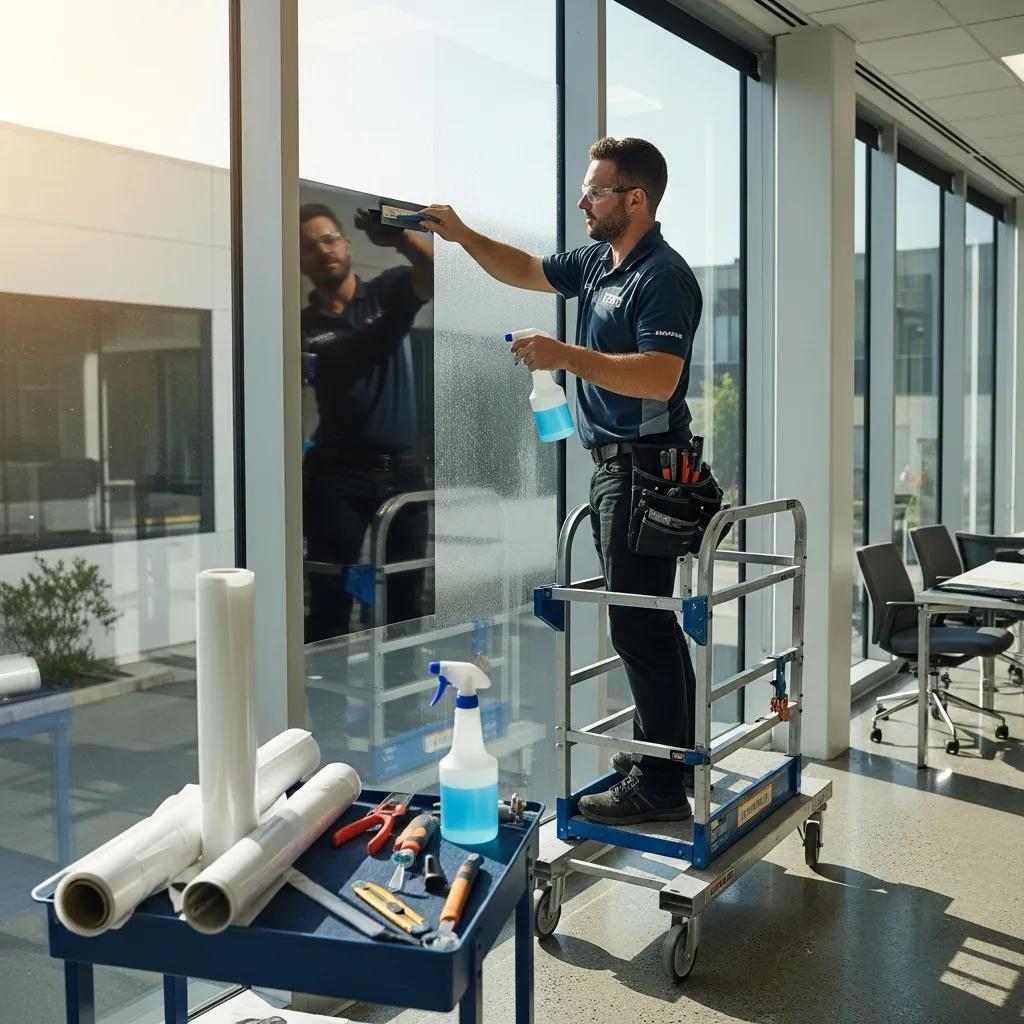
Professional commercial window tinting follows a predictable workflow from initial survey through final quality checks, with planning tuned to Bend’s sun patterns and seasonal weather. Installers evaluate glass type, orientation, facade access, and business schedules before recommending films and creating a detailed scope of work. Proper surface prep, accurate measurement and templating, careful application, and post‑install inspection ensure the film’s optical performance and adhesion. Multi-day or multi-facade projects should account for business hours, temperature and humidity limits, and any permit or code requirements when scheduling.
Alpha Shielding handles commercial window film projects end-to-end—matching films to building needs and installing them cleanly to deliver the promised performance.
What are the steps in a professional commercial window tinting installation?
A consistent installation sequence keeps performance predictable and minimizes business disruption.
We start with a detailed site survey and measurements to record glass types, frames, and access points. Next comes film selection and sample approval—choosing film models for VLT, SHGC, IR rejection, and appearance—followed by scheduling and any required surface remediation. On application day we perform thorough cleaning, cut and template the film, apply wet to avoid trapped particulates, squeegee out moisture and air, and trim edges cleanly. Post-install QA covers optical checks, adhesion verification, and a customer walkthrough with warranty paperwork.
Following this sequence reduces rework and helps the installed film meet the performance predicted during the proposal stage. It also sets you up for the maintenance practices that preserve film life, discussed next.
How does Alpha Shielding tailor film selection for Bend’s local climate?
We customize film recommendations by reviewing building orientation, window-to-wall ratio, internal thermal loads, and daily solar exposure patterns specific to Bend’s latitude and seasonal sun angles. For west-facing facades that face intense afternoon sun we typically recommend spectrally selective or ceramic films that maximize IR rejection while preserving visible light. For north- or east-facing glazing we select less aggressive VLT reductions so daylighting is maintained while SHGC control is moderate. Our assessment also considers film construction, glazing edge conditions, and occupant use to recommend products that deliver measurable energy and comfort gains without compromising appearance.
This targeted approach produces predictable HVAC load reductions and improved occupant comfort while avoiding one-size-fits-all mistakes that can over-darken interiors. The next section outlines the cost drivers and typical pricing considerations for commercial projects.
What factors influence the cost of commercial window tinting in Bend, Oregon?
Cost depends on film choice, square footage, access logistics, glazing condition, and any preparatory work. Premium ceramic and security films cost more up front but often provide stronger ROI through energy savings and risk reduction. Labor rises with project complexity—multi‑story facades needing lifts or scaffolding add time and safety planning. Edge treatments, removal of old film, glass repairs, and expedited schedules can also increase the total. The table below summarizes common cost factors and how they typically affect price to help with budgeting and procurement conversations.
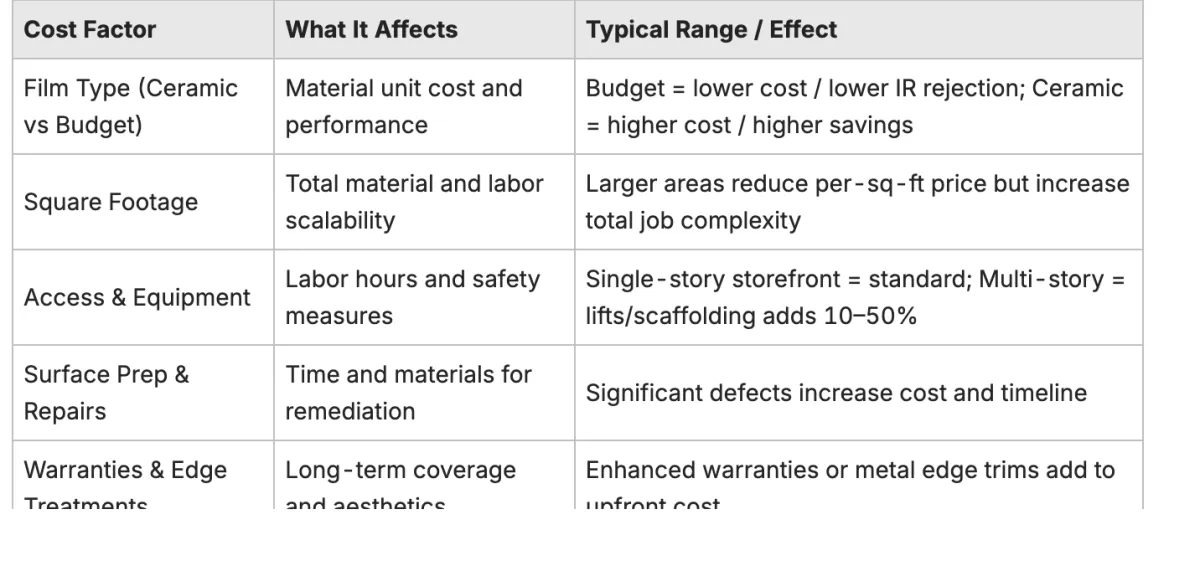
Knowing these drivers helps owners compare upfront cost against lifecycle savings and maintenance. The next subsection shows how film type and building size change pricing scenarios.
How do film type, building size, and installation complexity affect pricing?
Material choice is a big determinant of per‑square‑foot cost: premium ceramic or spectrally selective films have higher material prices but yield greater HVAC savings, while budget films cost less upfront but deliver smaller energy benefits. Building size scales labor: a single‑story storefront is often installed quickly with minimal equipment, while multi-story curtainwall projects require rigging, lifts, or swing stages and substantially higher labor and safety costs. Installation complexity—curved glazing, low-e coatings, or existing glass repairs—adds specialized labor and sometimes manufacturer sign-off, which raises the quote. Example scenarios clarify trade-offs and show why a site survey is critical for an accurate proposal.
Factoring long-term ROI into decisions often shows that higher upfront costs for premium films pay back through energy savings and deferred glazing replacement. The next subsection explains what facility managers should request to get reliable bids.
Where can businesses get accurate commercial window tinting quotes in Bend?
Accurate commercial quotes begin with an on-site survey documenting glass types, orientation, shading, and access constraints, plus sample cuts and a written proposal listing film specs and warranties. Ask installers for spec sheets showing VLT, SHGC, IR rejection, and UV blocking percentages, a clear scope of work that notes removal or remediation needs, and warranty terms covering both film and installation. Request local references or case studies and insist on itemized pricing that separates materials, labor, and equipment. Use a checklist of required documentation to compare bids on performance rather than only price.
A thorough quote reduces the chance of change orders and aligns expectations for schedule, performance, and warranty coverage. The next major section covers maintenance to protect your investment.
How can businesses maintain and extend the life of their commercial window film?
Routine maintenance and correct cleaning preserve optical clarity, adhesion, and warranty coverage—extending film life and maintaining energy performance. Inspect regularly for edge lift, bubbling, or discoloration so small issues can be fixed before replacement is needed. Follow cleaning protocols that avoid abrasives and ammonia-based cleaners and use soft squeegees to protect scratch-resistant topcoats. A scheduled maintenance plan coordinated with building operations reduces premature degradation and supports warranty claims when properly documented.
Maintenance also includes quick repairs after mechanical damage (for example, from contractors) and periodic professional inspections for multi-story installations. The subsections below provide cleaning best practices and lifespan expectations to guide facility teams.
What are best practices for cleaning and caring for commercial window films?
Clean films with a mild, non-abrasive detergent mixed with water and a soft microfiber cloth or squeegee, applied gently to avoid scratches or edge lift. Avoid ammonia-based cleaners, abrasive pads, and razor blades on the film—they damage the topcoat and can void warranties. Establish a routine cleaning schedule—monthly for busy facades or more often in dusty conditions—and inspect edges and sealants during each cleaning. Keep records of maintenance and any issues to support warranty claims and inform future replacement timing.
A simple in-house checklist helps building staff preserve film integrity and spot problems early, lowering lifecycle costs and downtime. The next subsection covers expected film lifespans in Bend’s climate.
How long does commercial window tinting typically last in Bend’s climate?
Lifespan depends on film technology and exposure: premium ceramic and spectrally selective films commonly last 10–15 years with proper maintenance and moderate exposure, while metalized and budget films typically show optical degradation or edge lift after 7–10 years. Security films may retain structural benefits longer but can show cosmetic wear depending on exposure and cleaning. Environmental factors—strong sunlight, temperature cycling, and moisture—affect adhesive life and topcoat durability, so regular inspection and proper cleaning are essential. Warranties generally reflect these ranges; keep installation and maintenance records to support any warranty work.
Planning replacement cycles around warranty expirations and expected performance decline helps maintain predictable lifecycle budgeting and preserves the retrofit’s energy and safety benefits.
Why choose Alpha Shielding LLC for commercial window tinting installation in Bend?
Alpha Shielding is a local specialist for commercial window film projects in Bend. Based here in Bend, Oregon, we also offer automotive detailing, ceramic coatings, and paint protection film (PPF) alongside commercial tinting. We prioritize quality products, skilled workmanship, and decades of combined experience—backed by a 4.9‑star rating from 37 Google reviews (as of April 2024). Our local knowledge of Bend’s sun angles and seasonal swings, plus a track record of quality installations, gives clients confidence in project outcomes.
Alpha Shielding installs commercial window film that reduces heat, glare, and energy costs while enhancing comfort and safety. We tailor material selection to each building and complete installs with careful attention to finish and performance.
What commercial projects has Alpha Shielding completed in Bend?
Our commercial work includes storefront retrofits, office privacy installations, and solar-control upgrades focused on measurable performance—categories that match our service capabilities. When we present projects we use a short case-study format: Problem → Solution (film type and installation approach) → Result (measured outcomes such as reduced glare or improved tenant comfort). Including before/after photos and client-approved metrics builds credibility; we recommend tracking interior temperature changes or tenant feedback when possible. This format helps prospective clients understand likely outcomes for similar scopes.
Sharing project metrics and visual documentation clarifies expected ROI and operational impacts for decision-makers considering commercial film retrofits.
What do Bend businesses say about their commercial window tinting experience?
Local reviews and references provide the best social proof: Alpha Shielding holds a 4.9‑star rating from 37 Google reviews as of April 2024, which reflects strong customer satisfaction in the area. Facility managers should ask for permission to publish testimonials and request verifiable references for similar building types when evaluating installers. Reviews reveal installation quality, follow-up service, and warranty responsiveness—factors that matter beyond film specs or price. Including local reputation in your vendor selection reduces procurement risk and sets clearer expectations.
Collecting documented outcomes and client permissions strengthens trust and helps buyers choose the right installer for commercial window film projects.
The tables and lists above summarize actionable steps, performance comparisons, and procurement checklists to support Bend facility managers planning commercial window film projects. Use the film comparison and cost-factor tables with the installation and maintenance guidance to form a complete decision package for budgeting, specification, and scheduling. This structured approach—define, explain, apply, and validate—helps turn film performance metrics into predictable operational and financial outcomes for commercial properties in Bend.
Frequently Asked Questions
What is the typical lifespan of commercial window tinting in Bend?
Lifespan depends on film type and exposure. Premium ceramic and spectrally selective films typically last 10–15 years with proper maintenance, while metalized and budget films usually last about 7–10 years before optical degradation or edge lift appears. Factors such as strong sunlight, temperature swings, and moisture affect adhesive and topcoat longevity. Regular inspections and proper cleaning help preserve performance and warranty coverage.
How can businesses choose the right window film for their needs?
Start by assessing building orientation, the need for UV protection, glare control, and energy savings. Consider VLT and SHGC targets that match your priorities. Consult with local professionals who understand Bend’s climate so you get film types and installation methods that deliver the performance and appearance you want.
What maintenance practices are recommended for commercial window films?
Use a mild, non-abrasive detergent with water and a soft microfiber cloth or squeegee. Avoid ammonia-based cleaners and abrasive tools that can harm the film’s topcoat. Inspect edges for lifting or bubbling and address issues quickly. Keep a maintenance log to track cleaning schedules and any observed problems—this helps with warranty claims and long-term planning.
Are there regulations or codes for window tinting in Bend?
Yes. Bend has regulations around visible light transmission and reflectivity to ensure safety and visibility. Check local building codes and zoning rules before installation. Working with an installer familiar with Bend’s regulations helps ensure compliance and avoids later adjustments.
What are the environmental benefits of commercial window tinting?
Window film reduces solar heat gain, lowering air‑conditioning demand and cutting energy use and associated emissions. By blocking UV radiation, films help protect furnishings and reduce replacement waste. Overall, film can improve a building’s sustainability profile and support environmental goals.
How does window film installation affect natural light in commercial spaces?
Films balance light transmission and heat rejection so natural light can remain while glare and heat are reduced. High-VLT films keep interiors bright, which supports productivity and atmosphere. Spectrally selective films are designed to filter infrared energy while allowing visible light through, keeping spaces well-lit without excess heat.
Conclusion
Commercial window tinting delivers meaningful benefits for Bend businesses: better energy efficiency, improved occupant comfort, and added safety. With the right film and a professional installation, property managers can reduce glare, protect interiors from UV damage, and lower energy costs. Understanding the installation steps and maintenance requirements ensures lasting performance. Contact Alpha Shielding to discuss tailored window film solutions for your building.
Paint protection film (PPF) offers numerous advantages for vehicle owners, primarily by preserving the aesthetic appeal and resale value of their cars. By applying PPF, you create a protective barrier that shields your vehicle from harmful elements such as UV rays, road debris, and environmental contaminants.
Additionally, PPF is designed to be self-healing, meaning minor scratches and swirl marks will disappear with heat exposure, maintaining the film's clarity and gloss. This longevity and durability make PPF an excellent investment for anyone looking to keep their vehicle looking new for years to come.
Installation Process of Paint Protection Film
The installation process of paint protection film is a meticulous procedure that ensures a perfect fit and finish on your vehicle. At Alpha Shielding LLC, our trained professionals begin by thoroughly cleaning the vehicle's surface to remove any contaminants that could affect adhesion.
Once the surface is prepared, the PPF is carefully measured and cut using precision tools, ensuring that every curve and contour of your vehicle is covered. The film is then applied using a specialized technique that minimizes air bubbles and ensures a seamless finish, allowing the protective layer to blend seamlessly with the car's paint.
Maintenance Tips for Paint Protection Film
To maximize the effectiveness and lifespan of your paint protection film, regular maintenance is essential. It is recommended to wash your vehicle with a pH-balanced car wash solution and avoid abrasive materials that could scratch the film's surface.
Additionally, consider applying a ceramic coating over the PPF for added protection against UV rays and chemical stains. Regular inspections for any signs of damage or lifting edges will help maintain the integrity of the film, ensuring your vehicle remains protected and visually appealing.
Frequently Asked Questions about Paint Protection Film
Many vehicle owners have questions regarding paint protection film, including its durability, warranty, and suitability for different types of vehicles. PPF is known for its high durability, often lasting up to 10 years or more with proper care.
Customers often inquire about the warranty coverage provided by Alpha Shielding LLC, which typically includes protection against yellowing, cracking, and bubbling. We encourage potential clients to reach out with any specific questions to ensure they have all the information needed to make an informed decision about their vehicle's protection.
Commercial window tinting is a retrofit that applies engineered window film to existing glass to manage solar heat gain, cut glare, block UV radiation, and improve safety. This guide breaks down how window film works, why it matters for building performance in Bend, Oregon, and how facility managers can evaluate options for offices, retail, healthcare, and multi-tenant properties. If your building wrestles with hot west-facing facades, faded interiors, or high cooling bills, you’ll find practical advice on choosing the right film, installation best practices, cost expectations, and maintenance strategies tuned to Bend’s sun angles and seasonal swings. We explain benefits (energy, comfort, security), film categories and performance metrics (VLT, SHGC, IR rejection), a step-by-step installation workflow, cost drivers and quoting tips, plus maintenance and lifespan expectations. Technical terms like solar control window film, ceramic film, security film, VLT, SHGC, and IR rejection are defined so both technical and non-technical stakeholders can decide with confidence.
What are the main benefits of commercial window tinting for Bend businesses?
Window film delivers measurable gains in energy performance, occupant comfort, UV protection, and safety by changing how glass transmits visible light and infrared heat. Properly selected films reduce solar heat gain and IR transmission, lowering peak cooling loads and smoothing temperature swings so occupants experience fewer hot spots. In retail and office spaces this cuts glare on displays and monitors and can block up to 99% of UV radiation, protecting furnishings and inventory from fading. Below are the principal, measurable benefits Bend property managers should expect.
Core benefits of commercial window tinting:
Energy savings: Reduces solar heat gain through glazing, which can lower cooling energy use and peak HVAC demand.
UV protection: Blocks the vast majority of UV radiation to slow fading of interiors and protect occupants.
Glare reduction: Controls reflected and transmitted glare to improve productivity and display visibility.
Security & safety: Safety films help keep glass fragments intact on breakage, reducing injury and deterring forced entry.
Privacy & aesthetics: Frosted and decorative films increase privacy and let you add branded graphics without replacing glazing.
Those benefits translate to lower monthly energy bills, longer-lasting furnishings, fewer tenant complaints about hot spots, and reduced security risk—making film a high-impact retrofit for many buildings. The next section digs into the energy and comfort mechanics so you can estimate likely savings and occupant impact.
At Alpha Shielding, we install commercial window film that cuts heat, reduces glare, and lowers energy costs while improving comfort and security. We select high-performance films for each building and install them precisely to meet your goals.
How does commercial window tinting lower energy costs and improve comfort?

Window film reduces energy use mainly by lowering the Solar Heat Gain Coefficient (SHGC) of glazed areas—reflecting or absorbing near-infrared (IR) radiation before it turns into interior heat. Films with high IR rejection and balanced Visible Light Transmission (VLT) let daylight in while preventing heat buildup, which cuts peak cooling loads and shortens HVAC run times. For example, a west-facing storefront in Bend fitted with spectrally selective ceramic film will see reduced interior solar load and lower midday cooling demand; total savings vary with orientation, glazing area, and your HVAC baseline.
Reducing peak HVAC cycles also improves comfort by eliminating hot spots near windows and stabilizing temperatures across zones.
These effects can extend HVAC life by reducing extreme runtimes and thermal stress. Choosing the right balance between VLT (daylight) and SHGC (heat) is key so occupants keep natural light without the thermal penalty. The next section covers UV and glare performance and typical protection levels.
How much UV protection and glare reduction can window film provide?
Most commercial window films block up to 99% of ultraviolet (UV) radiation—the main driver of fading in fabrics, wood finishes, and printed materials—so film preserves interiors and inventory and protects long-term asset value. Glare reduction is measured by changes in visible light transmission and reflected glare; films that lower direct-sun luminance or redirect transmitted light can substantially cut perceived glare, improving monitor visibility and customer comfort. For sensitive spaces—museums, retail displays, conference rooms—pairing spectrally selective film with interior shading gives the best balance of daylighting and glare control. Facility managers typically choose films by specifying VLT percentage and UV rejection targets to match each use case.
Industry literature supports the use of spectrally selective films to reduce solar gain, glare, and UV exposure in commercial glazing.
Spectrally Selective Window Films for Commercial Buildings After-market window films address this need effectively. Manufacturers offer a range of films that reduce passive solar gain, cut glare, and block UV radiation to meet varied end-user requirements. Spectrally selective window films, 2007
Blocking UV also lowers cumulative occupant exposure near windows and helps reduce visual fatigue from glare—both factors that influence productivity and comfort. With that in mind, the following section compares film categories that perform well in Bend’s climate.
Which types of commercial window films work best in Bend’s climate?
Picking the right film means balancing visible light, IR rejection, UV blocking, appearance, and security needs against budget and building orientation. Bend’s high day‑to‑night temperature swings and strong solar angles favor films that reject IR while preserving useful daylight—ceramic and spectrally selective options excel here. Security and privacy films are useful where safety or confidentiality is a priority, and decorative films deliver branding or wayfinding without swapping out glass. The table below compares common film types by key performance attributes so facility managers can match numeric metrics to Bend conditions.
As the table shows, ceramic and spectrally selective films are often the best first choice for Bend properties that need daylight with meaningful heat control. The next paragraphs outline solar-control film features and where to use them.
Alpha Shielding installs commercial window films designed to cut heat, glare, and energy costs while improving occupant comfort and security. We match film choice to each building and execute installations with care and attention to detail.
What features make solar control and ceramic films useful?
Ceramic and spectrally selective films use non-metal ceramic particles to block IR and portions of the near-IR spectrum while keeping visible transmission higher—so they reduce heat without overly darkening interiors. Typical construction includes a polyester film layer, adhesive, a scratch-resistant topcoat, and a ceramic particle layer that together deliver durability, strong adhesion, and stable optics. Unlike metalized films, ceramic options avoid metallic reflectivity and signal interference while holding long-term clarity and neutral color. For large storefronts or glazing where daylight and display visibility matter, ceramic films offer an attractive SHGC-to-VLT ratio that keeps interiors bright while lowering cooling loads.
Advances in spectrally selective thin films have enabled highly efficient, energy-saving window solutions.
Spectral Selective Thin Films for Energy Efficient Windows Spectrally selective designs and metal-based thin films are a promising approach to allow high visible light transmittance while reflecting near-infrared energy—an effective strategy for energy-efficient windows. Spectral selective and photothermal nano structured thin films for energy efficient windows, D Shi, 2017
Durability and lifecycle performance tend to favor ceramic options on high-exposure facades, and their neutral appearance supports architectural intent. After covering solar-control films, the next section looks at security, privacy, and decorative options for safety and branding needs.
How do security, privacy, and decorative films enhance commercial buildings?
Security (safety) films are engineered to hold glass fragments together on impact, enhancing occupant protection and delaying or deterring forced entry while typically preserving daylight. These films come in varying thicknesses and are installed with specialized adhesives and edge treatments to boost smash- and blast-resistance for storefronts and ground‑floor glazing. Privacy films—frosted, opaque, or reflective—manage sightlines for conference rooms, restrooms, and healthcare spaces, while decorative films allow logos, patterns, or wayfinding graphics without replacing glass. Anti-graffiti films act as a sacrificial layer in vandal-prone areas and are cheaper to replace than entire panes.
When preserving sensitive materials is critical, UV-blocking films are an essential part of environmental control strategies.
UV-Blocking Window Films for Artifact Preservation Institutions commonly use window films to block unwanted solar radiation. Darker films tend to offer higher UV rejection and are therefore used in museums and galleries where artifact preservation is a priority. UV-blocking window films for use in museums—revisited, 2010
Choosing among these options depends on function: safety films for protection, privacy films for confidentiality and compliance, and decorative films for brand expression. The next section explains how professional installations make these benefits reliable.
How is commercial window tinting installed in Bend?
Professional commercial window tinting follows a predictable workflow from initial survey through final quality checks, with planning tuned to Bend’s sun patterns and seasonal weather. Installers evaluate glass type, orientation, facade access, and business schedules before recommending films and creating a detailed scope of work. Proper surface prep, accurate measurement and templating, careful application, and post‑install inspection ensure the film’s optical performance and adhesion. Multi-day or multi-facade projects should account for business hours, temperature and humidity limits, and any permit or code requirements when scheduling.
Alpha Shielding handles commercial window film projects end-to-end—matching films to building needs and installing them cleanly to deliver the promised performance.
What are the steps in a professional commercial window tinting installation?
A consistent installation sequence keeps performance predictable and minimizes business disruption.
We start with a detailed site survey and measurements to record glass types, frames, and access points. Next comes film selection and sample approval—choosing film models for VLT, SHGC, IR rejection, and appearance—followed by scheduling and any required surface remediation. On application day we perform thorough cleaning, cut and template the film, apply wet to avoid trapped particulates, squeegee out moisture and air, and trim edges cleanly. Post-install QA covers optical checks, adhesion verification, and a customer walkthrough with warranty paperwork.
Following this sequence reduces rework and helps the installed film meet the performance predicted during the proposal stage. It also sets you up for the maintenance practices that preserve film life, discussed next.
How does Alpha Shielding tailor film selection for Bend’s local climate?
We customize film recommendations by reviewing building orientation, window-to-wall ratio, internal thermal loads, and daily solar exposure patterns specific to Bend’s latitude and seasonal sun angles. For west-facing facades that face intense afternoon sun we typically recommend spectrally selective or ceramic films that maximize IR rejection while preserving visible light. For north- or east-facing glazing we select less aggressive VLT reductions so daylighting is maintained while SHGC control is moderate. Our assessment also considers film construction, glazing edge conditions, and occupant use to recommend products that deliver measurable energy and comfort gains without compromising appearance.
This targeted approach produces predictable HVAC load reductions and improved occupant comfort while avoiding one-size-fits-all mistakes that can over-darken interiors. The next section outlines the cost drivers and typical pricing considerations for commercial projects.
What factors influence the cost of commercial window tinting in Bend, Oregon?
Cost depends on film choice, square footage, access logistics, glazing condition, and any preparatory work. Premium ceramic and security films cost more up front but often provide stronger ROI through energy savings and risk reduction. Labor rises with project complexity—multi‑story facades needing lifts or scaffolding add time and safety planning. Edge treatments, removal of old film, glass repairs, and expedited schedules can also increase the total. The table below summarizes common cost factors and how they typically affect price to help with budgeting and procurement conversations.
Knowing these drivers helps owners compare upfront cost against lifecycle savings and maintenance. The next subsection shows how film type and building size change pricing scenarios.
How do film type, building size, and installation complexity affect pricing?
Material choice is a big determinant of per‑square‑foot cost: premium ceramic or spectrally selective films have higher material prices but yield greater HVAC savings, while budget films cost less upfront but deliver smaller energy benefits. Building size scales labor: a single‑story storefront is often installed quickly with minimal equipment, while multi-story curtainwall projects require rigging, lifts, or swing stages and substantially higher labor and safety costs. Installation complexity—curved glazing, low-e coatings, or existing glass repairs—adds specialized labor and sometimes manufacturer sign-off, which raises the quote. Example scenarios clarify trade-offs and show why a site survey is critical for an accurate proposal.
Factoring long-term ROI into decisions often shows that higher upfront costs for premium films pay back through energy savings and deferred glazing replacement. The next subsection explains what facility managers should request to get reliable bids.
Where can businesses get accurate commercial window tinting quotes in Bend?
Accurate commercial quotes begin with an on-site survey documenting glass types, orientation, shading, and access constraints, plus sample cuts and a written proposal listing film specs and warranties. Ask installers for spec sheets showing VLT, SHGC, IR rejection, and UV blocking percentages, a clear scope of work that notes removal or remediation needs, and warranty terms covering both film and installation. Request local references or case studies and insist on itemized pricing that separates materials, labor, and equipment. Use a checklist of required documentation to compare bids on performance rather than only price.
A thorough quote reduces the chance of change orders and aligns expectations for schedule, performance, and warranty coverage. The next major section covers maintenance to protect your investment.
How can businesses maintain and extend the life of their commercial window film?
Routine maintenance and correct cleaning preserve optical clarity, adhesion, and warranty coverage—extending film life and maintaining energy performance. Inspect regularly for edge lift, bubbling, or discoloration so small issues can be fixed before replacement is needed. Follow cleaning protocols that avoid abrasives and ammonia-based cleaners and use soft squeegees to protect scratch-resistant topcoats. A scheduled maintenance plan coordinated with building operations reduces premature degradation and supports warranty claims when properly documented.
Maintenance also includes quick repairs after mechanical damage (for example, from contractors) and periodic professional inspections for multi-story installations. The subsections below provide cleaning best practices and lifespan expectations to guide facility teams.
What are best practices for cleaning and caring for commercial window films?
Clean films with a mild, non-abrasive detergent mixed with water and a soft microfiber cloth or squeegee, applied gently to avoid scratches or edge lift. Avoid ammonia-based cleaners, abrasive pads, and razor blades on the film—they damage the topcoat and can void warranties. Establish a routine cleaning schedule—monthly for busy facades or more often in dusty conditions—and inspect edges and sealants during each cleaning. Keep records of maintenance and any issues to support warranty claims and inform future replacement timing.
A simple in-house checklist helps building staff preserve film integrity and spot problems early, lowering lifecycle costs and downtime. The next subsection covers expected film lifespans in Bend’s climate.
How long does commercial window tinting typically last in Bend’s climate?
Lifespan depends on film technology and exposure: premium ceramic and spectrally selective films commonly last 10–15 years with proper maintenance and moderate exposure, while metalized and budget films typically show optical degradation or edge lift after 7–10 years. Security films may retain structural benefits longer but can show cosmetic wear depending on exposure and cleaning. Environmental factors—strong sunlight, temperature cycling, and moisture—affect adhesive life and topcoat durability, so regular inspection and proper cleaning are essential. Warranties generally reflect these ranges; keep installation and maintenance records to support any warranty work.
Planning replacement cycles around warranty expirations and expected performance decline helps maintain predictable lifecycle budgeting and preserves the retrofit’s energy and safety benefits.
Why choose Alpha Shielding LLC for commercial window tinting installation in Bend?
Alpha Shielding is a local specialist for commercial window film projects in Bend. Based here in Bend, Oregon, we also offer automotive detailing, ceramic coatings, and paint protection film (PPF) alongside commercial tinting. We prioritize quality products, skilled workmanship, and decades of combined experience—backed by a 4.9‑star rating from 37 Google reviews (as of April 2024). Our local knowledge of Bend’s sun angles and seasonal swings, plus a track record of quality installations, gives clients confidence in project outcomes.
Alpha Shielding installs commercial window film that reduces heat, glare, and energy costs while enhancing comfort and safety. We tailor material selection to each building and complete installs with careful attention to finish and performance.
What commercial projects has Alpha Shielding completed in Bend?
Our commercial work includes storefront retrofits, office privacy installations, and solar-control upgrades focused on measurable performance—categories that match our service capabilities. When we present projects we use a short case-study format: Problem → Solution (film type and installation approach) → Result (measured outcomes such as reduced glare or improved tenant comfort). Including before/after photos and client-approved metrics builds credibility; we recommend tracking interior temperature changes or tenant feedback when possible. This format helps prospective clients understand likely outcomes for similar scopes.
Sharing project metrics and visual documentation clarifies expected ROI and operational impacts for decision-makers considering commercial film retrofits.
What do Bend businesses say about their commercial window tinting experience?
Local reviews and references provide the best social proof: Alpha Shielding holds a 4.9‑star rating from 37 Google reviews as of April 2024, which reflects strong customer satisfaction in the area. Facility managers should ask for permission to publish testimonials and request verifiable references for similar building types when evaluating installers. Reviews reveal installation quality, follow-up service, and warranty responsiveness—factors that matter beyond film specs or price. Including local reputation in your vendor selection reduces procurement risk and sets clearer expectations.
Collecting documented outcomes and client permissions strengthens trust and helps buyers choose the right installer for commercial window film projects.
The tables and lists above summarize actionable steps, performance comparisons, and procurement checklists to support Bend facility managers planning commercial window film projects. Use the film comparison and cost-factor tables with the installation and maintenance guidance to form a complete decision package for budgeting, specification, and scheduling. This structured approach—define, explain, apply, and validate—helps turn film performance metrics into predictable operational and financial outcomes for commercial properties in Bend.
Frequently Asked Questions
What is the typical lifespan of commercial window tinting in Bend?
Lifespan depends on film type and exposure. Premium ceramic and spectrally selective films typically last 10–15 years with proper maintenance, while metalized and budget films usually last about 7–10 years before optical degradation or edge lift appears. Factors such as strong sunlight, temperature swings, and moisture affect adhesive and topcoat longevity. Regular inspections and proper cleaning help preserve performance and warranty coverage.
How can businesses choose the right window film for their needs?
Start by assessing building orientation, the need for UV protection, glare control, and energy savings. Consider VLT and SHGC targets that match your priorities. Consult with local professionals who understand Bend’s climate so you get film types and installation methods that deliver the performance and appearance you want.
What maintenance practices are recommended for commercial window films?
Use a mild, non-abrasive detergent with water and a soft microfiber cloth or squeegee. Avoid ammonia-based cleaners and abrasive tools that can harm the film’s topcoat. Inspect edges for lifting or bubbling and address issues quickly. Keep a maintenance log to track cleaning schedules and any observed problems—this helps with warranty claims and long-term planning.
Are there regulations or codes for window tinting in Bend?
Yes. Bend has regulations around visible light transmission and reflectivity to ensure safety and visibility. Check local building codes and zoning rules before installation. Working with an installer familiar with Bend’s regulations helps ensure compliance and avoids later adjustments.
What are the environmental benefits of commercial window tinting?
Window film reduces solar heat gain, lowering air‑conditioning demand and cutting energy use and associated emissions. By blocking UV radiation, films help protect furnishings and reduce replacement waste. Overall, film can improve a building’s sustainability profile and support environmental goals.
How does window film installation affect natural light in commercial spaces?
Films balance light transmission and heat rejection so natural light can remain while glare and heat are reduced. High-VLT films keep interiors bright, which supports productivity and atmosphere. Spectrally selective films are designed to filter infrared energy while allowing visible light through, keeping spaces well-lit without excess heat.
Conclusion
Commercial window tinting delivers meaningful benefits for Bend businesses: better energy efficiency, improved occupant comfort, and added safety. With the right film and a professional installation, property managers can reduce glare, protect interiors from UV damage, and lower energy costs. Understanding the installation steps and maintenance requirements ensures lasting performance. Contact Alpha Shielding to discuss tailored window film solutions for your building.
Follow Us


Services
Quick Links
Legal
Copyright Alpha Shielding LLC. All Rights Reserved.